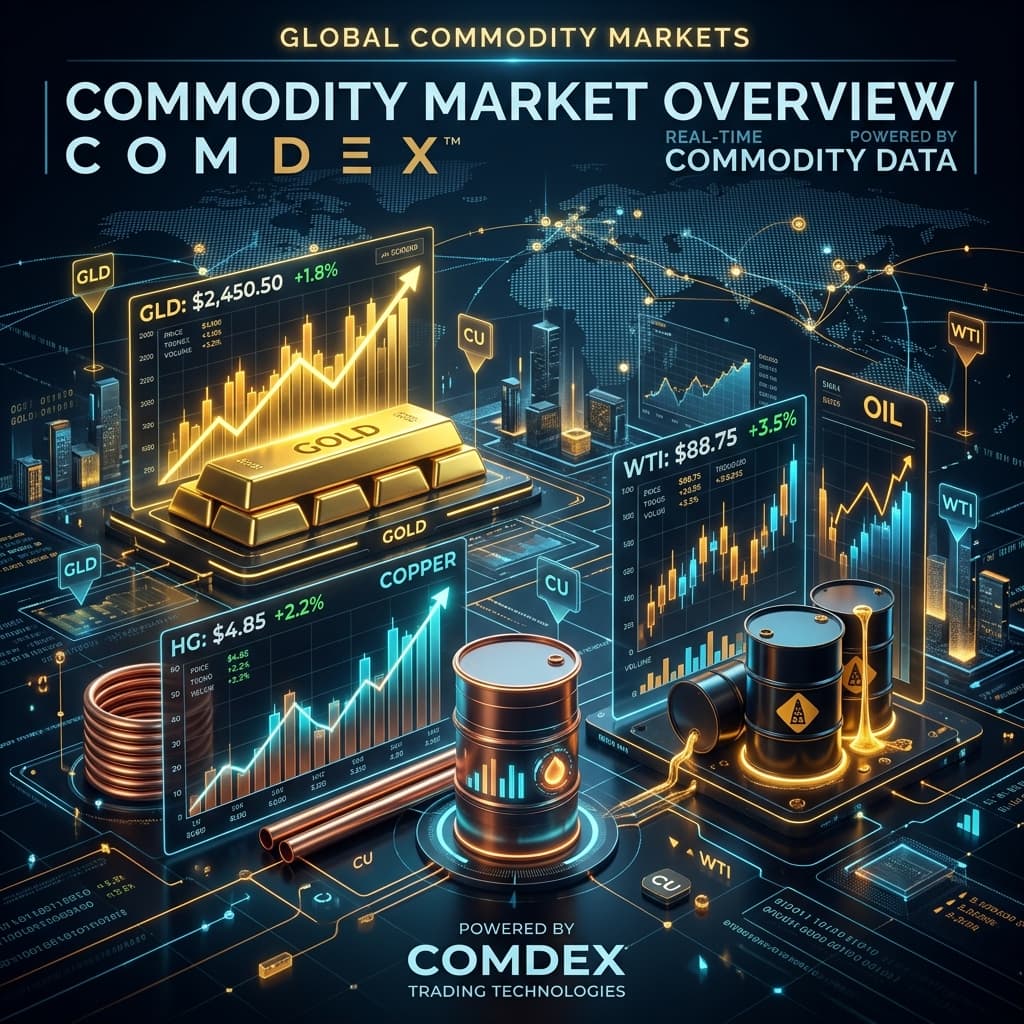
Fed's Hawkish Stance Pressures Gold Below $4,150 as Oil Stages Modest Rebound
Monday, June 23, 2026 Commodity markets opened the week under broad-based selling pressure as the U.S. Federal Reserve's hawkish posture from last week's FOMC meeting continued to reverberate across asset classes. The dollar strengthened near its highest levels since May 2025, weighing on non-yielding commodities. Precious metals bore the brunt of the selloff, while crude oil managed a modest recovery on lingering geopolitical uncertainties in the Middle East. Base metals traded mixed as traders balanced stronger dollar headwinds against long-term demand fundamentals driven by the global energy transition.
Precious Metals
Gold fell to $4,142.68/oz, down approximately 0.75-1.07% on the session, as the metal continued to struggle below the psychologically important $4,200 level. The DXY index firmed at 101.04, reflecting markets pricing in a "higher-for-longer" rate trajectory under new Fed Chair Kevin Warsh, whose Summary of Economic Projections raised inflation forecasts and left the door open for potential rate hikes.
Technical indicators paint a bearish picture: RSI sits in the 33-41 range, signaling weak momentum without yet reaching deeply oversold territory. Gold is trading below its EMA50 and within a descending trend channel. Key support sits at the $4,100-$4,125 zone, with a break below $4,020-$4,050 potentially triggering a deeper correction toward $3,880. Resistance remains firmly entrenched at $4,200-$4,220, where repeated rallies have been rejected.
Silver tracked gold lower, falling to $63.77/oz (down ~1.96%), while platinum declined 2.24% to $1,640/oz as institutional investors unwound defensive positions. Palladium dropped 2.13% to the $1,250 range, weighed down by ongoing concerns over shrinking industrial demand as the EV transition displaces internal combustion engine vehicles and a projected global PGM surplus for 2026.
| Metal | Price | Daily Change |
|---|---|---|
| Gold (XAU) | $4,142.68/oz | -0.75% |
| Silver (XAG) | $63.77/oz | -1.96% |
| Platinum (XPT) | $1,640/oz | -2.24% |
| Palladium (XPD) | $1,250/oz | -2.13% |
Energy
Crude oil staged a modest rebound after last week's sharp selloff. Brent crude edged up 0.38% to $78.15/bbl, while WTI gained 0.46% to $74.19/bbl. The recovery came as markets reassessed the fragile diplomatic landscape surrounding U.S.-Iran ceasefire negotiations in Switzerland.
While progress in the talks has been described as "encouraging," the 60-day sanctions waiver granted to Iran and the normalization of tanker traffic through the Strait of Hormuz suggest markets may be pricing in too much supply relief too quickly. Analysts caution that the situation remains fragile, and any breakdown in diplomacy could rapidly re-introduce risk premiums.
On the structural demand side, OPEC released its 20th World Oil Outlook during the Vienna Development Forum, projecting global energy demand to rise 23% by 2050, with oil demand reaching 124 million barrels per day. The report emphasized that $17.7 trillion in upstream investment will be needed over the 2026-2050 period to meet this demand a bullish signal for long-term price expectations despite near-term weakness.
Base Metals
Base metals traded under moderate pressure from the stronger dollar but found support from long-term demand fundamentals tied to electrification and renewable energy buildout.
Copper held relatively steady on the LME at $13,530/tonne (cash), with three-month contracts at $13,597. While Chinese imports of copper concentrate remain subdued and traditional industrial sectors show weakness, offsetting demand from renewable energy installations, battery storage, and electronics manufacturing is keeping the market balanced. Constrained mine supply continues to support the longer-term outlook.
Aluminum traded at $3,399/tonne, with the market still digesting the Trump administration's Section 232 tariff modifications that took effect on June 8. The revised framework reduced tariffs from 25% to 15% on certain agricultural and industrial equipment, while adding aluminum lithographic plates to the 25% duty list. The U.S.-origin content threshold was lowered from 95% to 85%, potentially opening the door for more domestic producers to qualify for the preferential 10% rate.
Zinc held at $3,584/tonne, nickel at $17,588/tonne, and lead at $1,934/tonne on the LME, all trading within narrow ranges as the market awaits clearer macro direction.
| Metal | LME Cash ($/t) | LME 3-Month ($/t) |
|---|---|---|
| Copper | $13,530 | $13,597 |
| Aluminum | $3,399 | $3,398 |
| Zinc | $3,584 | $3,589 |
| Nickel | $17,588 | $17,765 |
| Lead | $1,934 | $1,968 |
The Comdex View
The dominant narrative this week is clear: the Federal Reserve's hawkish recalibration is reasserting the dollar's gravitational pull on commodity prices. With the DXY trading near 13-month highs and markets pricing in potential rate hikes under Chair Warsh's stewardship, non-yielding assets face a structural headwind that is unlikely to dissipate until incoming data particularly the upcoming PCE inflation print provides clarity on the Fed's next move.
However, this sell-the-surface environment masks a more complex underlying picture. Global commodity stockpiles continue to erode, leaving markets vulnerable to supply shocks. OPEC's long-term demand projections underscore the structural underinvestment thesis that has supported commodity prices throughout this cycle. And the Iran diplomatic situation, while superficially de-escalatory, remains one headline away from reversing.
For gold specifically, the $4,100-$4,125 support zone is the critical line in the sand. A decisive break below this level could trigger a deeper correction, but the metal's structural role as an inflation hedge particularly with the Fed itself revising inflation expectations higher suggests that any significant drawdown will likely attract buying interest. The disconnect between hawkish rhetoric and still-elevated inflation expectations creates a tension that, in our view, resolves in favor of hard assets over the medium term.
Base metals remain the quiet story. Copper's resilience near $13,500 despite dollar strength reflects the market's recognition that the electrification supercycle is not a sentiment trade it is a physical reality that will require substantially more metal than current mine supply can deliver.
Ready to trade?
Trade Commodities on Comdex