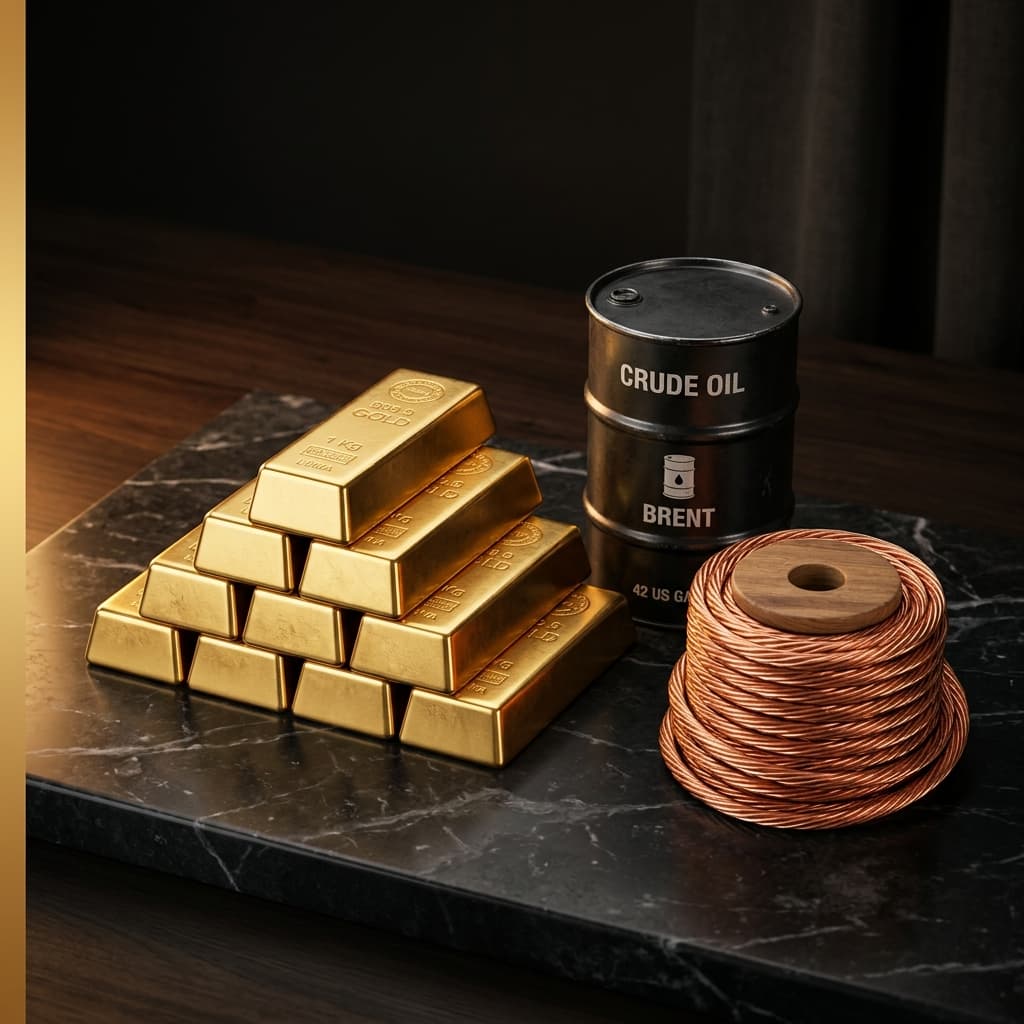
Gold Breaks Below 200-DMA as Hot CPI Crushes Rate Cut Hopes, Oil Surges Past $94 on Hormuz Closure
Commodity markets are splitting in two. Oil surged past $94 as Iran declared the Strait of Hormuz closed to all vessel traffic, while gold — traditionally the crisis asset — fell to a seven-month low near $4,065 after US inflation data came in hotter than expected, effectively ending hopes for near-term Fed rate cuts. Base metals sold off broadly as risk-off sentiment and stagflation fears gripped markets.
Market Pulse
| Asset | Price | Signal |
|---|---|---|
| Gold (XAU) | $4,065/oz | Below 200-DMA for the first time since 2003 |
| Silver (XAG) | $63.50/oz | Rebounded from 11-week low at $61.50 |
| Platinum (XPT) | $1,666/oz | Pressured alongside gold |
| Palladium (XPD) | $1,245/oz | BofA maintains bullish outlook |
| Brent Oil | $94.80/bbl | Hormuz closure triggers supply panic |
| Copper | $13,449/t | 3-week low on risk-off selling |
Sentiment Overview
Energy
Oil is the dominant story. Iran's military command declared the Strait of Hormuz — through which roughly 20% of global oil flows — completely closed to all vessels, and the IRGC Navy confirmed it struck two ships attempting passage. This followed a second consecutive night of US strikes on Iranian air defenses, radar systems, and naval assets.
Iran widened the conflict by firing missiles at US bases in Jordan, Kuwait, and Bahrain. Brent briefly touched $94.80 before settling near $94, supported further by EIA data showing a 7.2 million barrel crude draw and refinery utilization hitting 95.3%.
Trump claimed Iran asked for a halt to bombing and said strikes would stop shortly, but Tehran denied any contact.
A commentary from ForexLive warns global onshore inventories including SPR are roughly six weeks from operational minimums, suggesting the market may be significantly underpricing tail supply risk.
Precious Metals
Gold is in a paradox: a full-blown Middle East conflict should be driving safe-haven flows, but instead it fell below $4,050 — the lowest since November 2025. The culprit is US inflation. May CPI printed at 3.8% year-over-year, above the 3.6% consensus, with core CPI at 3.4%.
This has effectively killed expectations for a rate cut at the June 16–17 FOMC meeting, pushing Treasury yields higher and the dollar (DXY ~99.95) to levels that crush non-yielding assets. Gold broke below its 200-day moving average for the first time since October 2003 and lost the March low at $4,099.
However, central bank buying remains a structural floor — Georgia's central bank added $100 million and global central banks accumulated 970 tonnes in Q1 alone, close to 80% of all 2025 purchases. Silver rebounded from an 11-week low of $61.50 to trade around $64 but remains under pressure from the strong dollar.
Base Metals
The base metals complex sold off broadly as the US-Iran escalation triggered risk-off positioning across industrial commodities. Copper fell 0.8% to $13,449/tonne — a three-week low — as the Bloomberg report highlighted the direct impact of the conflict.
However, the Financial Times notes that the Iran war is tightening a "super-squeeze" in metals markets, with supply disruptions layering on top of pre-existing tightness from AI-driven demand. Chinese copper inventories declined for eight consecutive days to their lowest level this year.
Nickel was the worst performer, plummeting as hot CPI data and weak downstream procurement sentiment compounded the selloff. Palladium was the sole bright spot, rising 3% on SHFE after Bank of America maintained its bullish outlook.
Key Levels to Watch
- Gold at $4,000: This psychological level is the next major support after the March low broke. A sustained break below $4,000 opens the door to a rapid decline toward the $3,300–$3,500 zone, where stronger structural buying interest is expected.
- Brent Oil at $95–$100: If the Hormuz closure proves enforceable and sustained, Brent could quickly test triple digits. The $95 level — last seen in late April — is the immediate resistance. The FT warns that while inventories have provided a buffer so far, that cushion is eroding fast.
- FOMC June 16–17: The meeting is now the single most important macro event for precious metals. With hot CPI data in hand, any hawkish signal from the dot plot or Powell's press conference could extend gold's decline. A dovish surprise would trigger a sharp reversal.
The Comdex View
We are witnessing a historic decoupling: the world's most important safe-haven asset is falling during the most significant military escalation since the Gulf War. The explanation is simple but powerful — inflation is winning the tug-of-war against geopolitics. As long as the Fed is boxed into a higher-for-longer stance by 3.8% CPI, gold cannot fulfill its traditional role because the opportunity cost of holding it keeps rising. Oil, meanwhile, is pricing in a genuine supply emergency. With inventories six weeks from operational minimums and the Strait of Hormuz under active interdiction, the risk is firmly skewed to the upside. Bottom line: This is not a market for passive positioning. The next 48 hours — Trump's deadline for an Iran deal and the FOMC meeting — will determine whether we get relief or a further escalation across all asset classes.